Bridging materials science, device engineering, and urology, 2024 Schmidt Science Fellow Wonjun Yim has invented a highly sensitive test for early-stage bladder cancer that could transform patients’ lives.
Soon, he will start his own lab at the University of Wisconsin–Madison, taking the next step in his interdisciplinary career and bringing together AI, automation, and molecular engineering for materials discovery.
Nearly 600,000 people worldwide are diagnosed with bladder cancer each year, making it the world’s tenth most common cancer.
Unfortunately, around half of those cases will recur, so patients must be monitored closely for the rest of their lives.
The disease is usually diagnosed using cystoscopy (a camera on a flexible tube put inside the bladder) followed by a biopsy.
A less invasive way to pick up bladder cancer is to test a patient’s urine for cancer-specific protein biomarkers, molecules that can signal that cancer is present.
But these are easy to miss in early-stage cancers.
“When we rely on blood or urine samples to detect biomarkers, there’s a high chance that we can lose them,” explains Wonjun. “That is because when these proteins are secreted by a cancer cell, they are diluted and they degrade over time.”
In just two short years as a Schmidt Science Fellow at MIT, Wonjun has invented, built, and tested a new bladder cancer diagnostic device that is 182 times more sensitive than currently used urine biomarker tests.
His work was recently published in Nature Nanotechnology.
Wonjun’s idea was to catch biomarkers at their source to maximize their detection.
“I imagined that if I could combine nanotechnology with cystoscopy, we could see the biomarkers immediately, instead of taking a biopsy while the patient is under anesthetic,” he explains.
Wonjun’s test uses a ring-shaped nanosensor: an extremely tiny sensor that works at the scale of billionths of a meter.
Multiple identical nanosensors are mounted on a thin (5 mm) catheter that is inserted into the bladder.
The surface of each nanosensor is coated with specially designed synthetic polymers (long chains of repeating chemical units) that specifically recognize a bladder cancer biomarker called NMP-22.
Under near-infrared light, the nanosensors light up. When NMP-22 is detected, the nanosensors’ glow changes.
A small, rotating, ball-shaped optical lens beneath the nanosensors captures these changes, mapping the location of cancer cells inside the bladder.
“It produces a three-dimensional chemical image. We can see the biomarker being released from the cancer cells. That would otherwise be invisible to the naked eye,” he explains.
His findings showed that the device can image NMP-22 release inside pig bladders from distances of up to 2 cm away. The device can also distinguish between healthy cells and six genetically distinct types of bladder cancer cells.
If these findings translate to clinical use, patients could benefit from an instant, highly sensitive test in their doctor’s office.
“Patients would no longer need to suffer biopsies,” explains Wonjun. “It could drive early detection by immediately identifying cancerous regions. And this tool could be applied to other cancers accessible via endoscopy, such as bowel and stomach cancers,” he adds.
“It has been very, very challenging. I experienced so much trial and error and many failures. But Schmidt Science Fellows gave me the courage, positive energy, and the resilience to never give up.”
It has been a steep learning curve for Wonjun. After completing his PhD in materials science at the University of California, San Diego, his Fellowship gave him the opportunity to make an ambitious interdisciplinary pivot.
He first moved into molecular engineering to develop the NMP-22 nanosensors and then used his engineering experience to integrate them with the optical device.
“It has been very, very challenging. I experienced so much trial and error and many failures. But Schmidt Science Fellows gave me the courage, positive energy, and the resilience to never give up,” he says.
“The Schmidt Science Fellows community was so passionate, so inspirational. By joining them, I learned the value of people: being kind, generous, and sharing knowledge, assets, and energy.
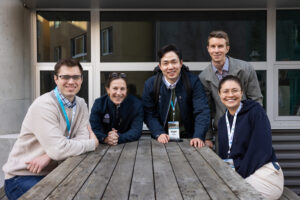
“And of course, I did not achieve this alone. It was teamwork. I met amazing scientists and engineers who all contributed their expertise across disciplines,” he adds.
While the test shows promise, further development is needed before it reaches patients.
“One biomarker may not be enough because biomarkers vary between people,” explains Wonjun.
“The next step is to customize the test to account for differences in biomarkers between patients. That means developing devices with multiple sensors and gathering more patient data to identify the most informative biomarkers.”
Wonjun is now preparing to push his interdisciplinary approach even further.
At his new laboratory at the University of Wisconsin–Madison, he will harness AI, large-scale automation, and molecular engineering to expand the possibilities of his research.
With the help of Google DeepMind’s AlphaFold, an AI system that predicts protein structures, he intends to create a diverse library of biological molecules to better understand how they recognize and interact with each other.
“When I designed the sensor, it was all about the polymer chemistry and molecular engineering. I had to manually synthesize, purify, and screen many different types of chemical structures, which took a long time,” he explains.
AI and automation will help Wonjun overcome some of the limitations of doing this work manually. He also plans to integrate machine learning into his research, using large-scale, high-quality experimental datasets to train models that can guide the discovery of new biological molecules.
Reflecting on this next stage, Wonjun describes his new area of expertise as another ‘dot’ that he hopes to connect with others.
“When I create this ‘dot’ I am confident I will make it connect with other dots to create a network bridging people and disciplines, as I did during my Fellowship,” he says.
It is the next step in an exciting journey.
Wonjun’s long-term career goal is to foster the next generation of scientists and leaders to embrace interdisciplinary research, a fitting legacy for a Schmidt Science Fellow.

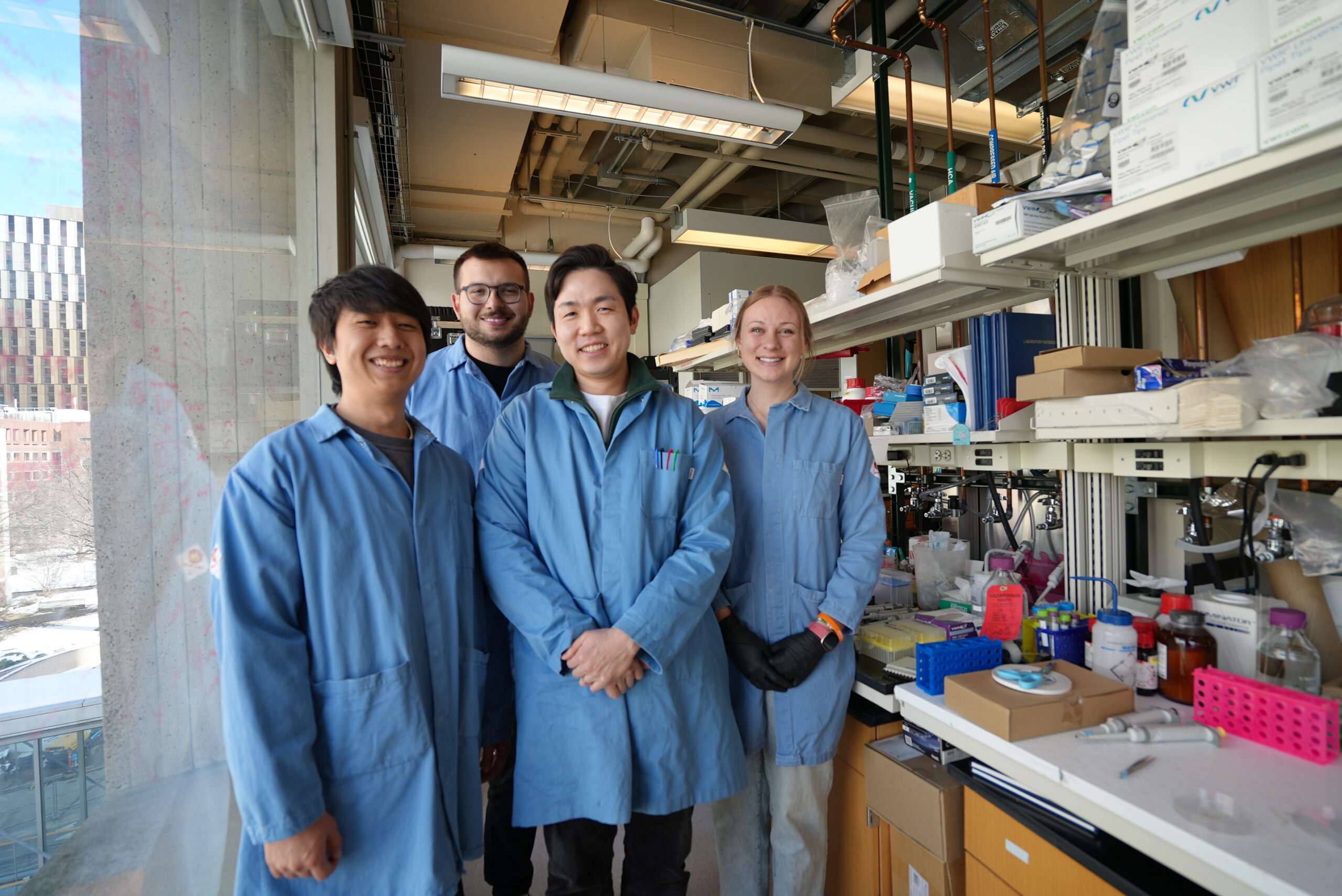
Photo under title: Wonjun and his team members at the Strano Research Group at MIT, who contributed to the project’s success. From the left: Hohyung Kang, Marco Machado, Wonjun Yim, and Maeve E. McGinnis. Credit: Melanie Gonick.
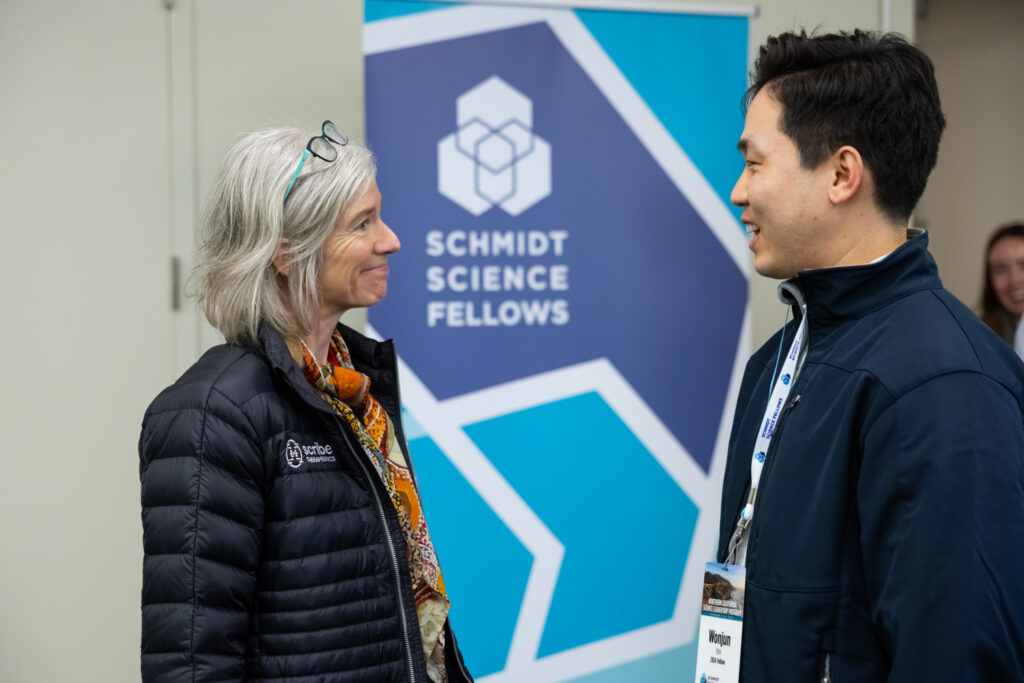
Other photos: Credit: Claudine Gossett.