Recognition of interdisciplinary research in tenure and promotion emerges as a clear area for institutional development from the Times Higher Education Interdisciplinary Science Rankings (ISR) 2027, in association with Schmidt Science Fellows.
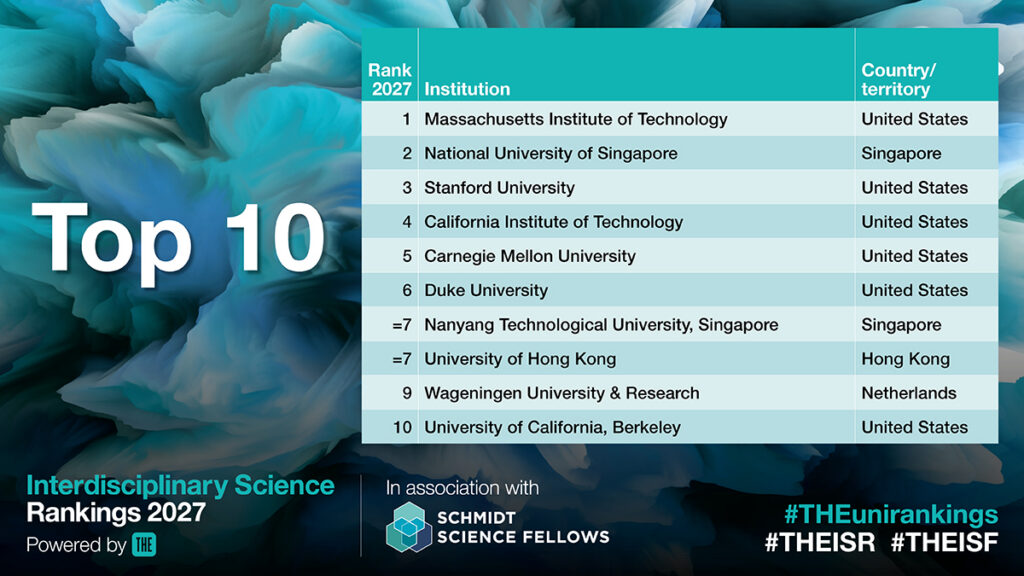
The Massachusetts Institute of Technology tops the ISR for the third year running, with the United States continuing to dominate the elite tier of the table, with six universities ranked among the top 10.
And participation in the initiative, designed to surface and champion interdisciplinary best practice, has grown to a record 1,058 institutions across 102 countries or territories. This is up 16% from the 2026 edition and demonstrates continued momentum.
Times Higher Education (THE)’s Chief Global Affairs Officer, Phil Baty, said that made the initiative “the most rapidly growing university ranking in the world.”
Explore the Full Rankings:
The ISR was launched three years ago as a key element of Schmidt Science Fellows’ mission to break down barriers to interdisciplinary science and accelerate positive impacts for global society.
“The Rankings turn a shared commitment to interdisciplinary science into meaningful institutional and systems change.” – Dr. Megan Kenna
Dr. Megan Kenna, Executive Director of Schmidt Science Fellows, said: “We know Interdisciplinary thinking can help address the most complex challenges facing society, but ambition alone is not enough.
“The Interdisciplinary Science Rankings provide institutions with valuable insight into how support for interdisciplinary science can be strengthened.
“By understanding where progress is being made, identifying barriers, and learning from one another, universities can make more informed choices about the structures, incentives, and cultures that allow researchers to work across disciplinary boundaries.
“The Rankings turn a shared commitment to interdisciplinary science into meaningful institutional and systems change.”

Asia’s expanding interdisciplinary strength is also reflected in this year’s Top 20.
Singapore’s National University of Singapore has risen to number two, up from number eight, and Nanyang Technological University, Singapore, is at joint seventh with the University of Hong Kong.
In total, seven Asian universities are among the global top 20, up from five last year.
The full data analysis shows that globally, support for interdisciplinary science research is more firmly built into universities’ infrastructure and administration than into their academic career systems, which makes tenure and career promotion the clearest shared area for development.
This opportunity was also highlighted recently by the Global Higher Education Interdisciplinary Network, an initiative of THE and Schmidt Science Fellows that brings together senior university leaders from seven regions worldwide and creates a peer-led space for dialogue, shared learning, and the exchange of practical experience.
Beyond the rankings themselves, institutions have reported using the ISR framework as a strategy tool to identify their own strengths and gaps, and prioritize action.
Feedback provided during ISR data collection shows that many respondents have cited new cross-faculty collaboration mechanisms, shared infrastructure, capacity-building initiatives, or dedicated funding since taking part.
“Bringing different disciplines together allows us to ask new questions, challenge assumptions, and pursue discoveries that would otherwise remain out of reach.” – Stu Feldman
Dr. Stu Feldman, President of Schmidt Sciences, said: “Bringing different disciplines together allows us to ask new questions, challenge assumptions, and pursue discoveries that would otherwise remain out of reach.”
“The growing participation in the Times Higher Education Interdisciplinary Science Rankings reflects momentum across universities.
“It is helping build a global community of universities committed to learning from one another and giving researchers the freedom, support, and connections to work across boundaries. That community has the potential to reshape how we nurture scientific talent and turn bold ideas into discoveries that benefit society.”
THE is the global leader in developing robust and trusted Rankings methodologies to help institutions measure and understand their own portfolios and performance, drawing out what is contributing to progress.
The ISR analysis is based on three pillars – Inputs, Processes, and Outputs – with transparent metrics providing a clear roadmap for institutions to progress.
Inputs include dedicated interdisciplinary funding. The Process pillar examines internal processes and structures that support and incentivize interdisciplinarity, including physical space, administrative support, and promotion.
The Output pillar measures interdisciplinary bibliometrics and global reputation.
“This vital work that crosses the divide between traditional academic disciplines will push forward the boundaries of our collective knowledge.” – Phil Baty
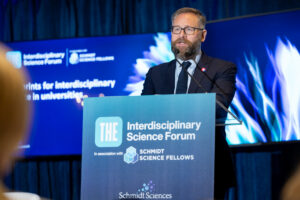
Phil Baty, THE’s chief global affairs officer, said the ISR had fast established itself in the academic and research landscape and now represented something much larger within the sector.
He said: “The Interdisciplinary Science Rankings have rapidly moved well beyond a standard ranking exercise into a global movement of universities committed to breaking down traditional academic silos and to collaborating across borders.
“This vital work that crosses the divide between traditional academic disciplines will push forward the boundaries of our collective knowledge.
“To now have over 1,000 universities from 102 countries taking part, in just the third annual edition of the ranking, makes this the most rapidly growing university ranking in the world, and represents a moment of real celebration.”
Across continents, Asia has the most ranked institutions, 565, up from 478 last year. Europe is the next best represented, with 218 institutions, followed by Africa (113), South America (83), North America (74) and Oceania (5).
Asia and Latin America are driving up the total representation in rankings. Asia added the most ranked universities compared with last year, with 87, followed by South America (22), Africa, and Europe (both at 15).
Countries ranked for the first time are Albania, Bahrain, Bosnia and Herzegovina, Croatia, Iceland, Kosovo, Kyrgyzstan, Malawi, Nepal, Qatar, Senegal, Serbia and Sweden.
The analysis published alongside the Rankings also looks ahead and acknowledges how AI is reshaping the interdisciplinary landscape.
A deeper dive into AI’s impact is currently being undertaken by the Global Higher Education Interdisciplinary Network (GHEIN).
Discussions across GHEIN regional chapters have informed a forthcoming GHEIN report on AI, surfacing opportunities and challenges at the global level and highlighting how they intersect differently by region.